All published articles of this journal are available on ScienceDirect.

Lekki Deep Seaport: Characterizations of Regulatory Frameworks and Operational Procedures on Attainment of Blue Economy Goals
 iD
iD
Authors Info & Affiliations
Abstract
Introduction
The research investigated the impact of frameworks and Standard Operating Procedures (SOPs) on the attainment of Blue Economy (BE) goals for sustainable port management and the responsible exploitation of ocean resources at the Lekki Deep Sea Port (LDSP) in Lagos, Nigeria.
Methods
Multistage and simple random sampling techniques were utilized to sample the 375 respondents who are members of the host communities. The sampled respondents provided the required information on the study objectives through a self-reporting questionnaire. Structural Equation Modelling (SEM) was used to test the derived hypotheses.
Results
Hypothetical tests revealed that the path from regulatory frameworks to SOPs was significant (β1=0.23, t = 2.96, p =.03), the test equally showed that the path from regulatory framework’ to responsible exploitation of ocean resources was significant (β2=0.31, t = 4.74, p<.001) as well as the the path from ‘SOP’ to sustainable port development (β3 = 0.57, t = 9.43,p<.001), finally the test affirmed that the path from SOP to responsible exploitation of ocean resources was also significant (β4 = 0.47,t = 9.82, p<.001).
Discussion
Results of the SEM that tested the derived hypotheses affirmed that there are elements of predictability in the relationships between all the identified endogenous and exogenous variables.
Conclusion
The study advocated for a more balanced approach in managing the Triple Bottom Line (TBL) derivatives by the LDSP, as findings suggest a potential prioritization of economic objectives, which may impact the balanced attainment of social and environmental goals.
1. INTRODUCTION
The Blue Economy (BE) has gained prominence in recent years, as nations increasingly prioritize sustainable approaches to leverage ocean resources for economic development and ecological preservation [1-2]. As global awareness around BE expands, its development relies heavily on coordinated strategies that integrate scientific and innovative methodologies aimed at fostering ocean sustainability. The scope of BE spans several sectors, such as aquaculture, shipping, international trade, coastal management, tourism, offshore energy, and the sustainable oversight of environmental resources [1-3].
Defined as the sustainable use of oceanic resources for economic growth, enhanced livelihoods, and job creation while safeguarding marine ecosystems, BE is now recognized as a pivotal contributor to global economic development, particularly for coastal and island regions [1-4]. The viability of the blue economy depends on delivering diverse ecosystem services while preserving the natural resources on which they depend [5]. With about 90% of global trade occurring via maritime routes, BE's economic influence is substantial. The global BE sector is projected to surpass USD 3 trillion by 2030, and over 3 billion people presently depend on it for their livelihoods [3-5].
Beyond economic benefits, the blue economy offers indispensable ecological services. Oceans play a vital role in absorbing excess heat from global warming, provide roughly half of the world's oxygen, sequester around 3 billion tons of carbon dioxide annually, and serve as buffers protecting coastal communities from natural disasters [1, 6, 7]. These environmental functions are crucial to sustaining human and planetary well-being.
In the context of the blue economy, ports are critical enablers of maritime trade, facilitating the smooth movement of goods across international borders. Efficient and modern port infrastructure helps reduce transportation costs, bolsters economic competitiveness, and positions countries favorably within the global market [7-10]. Thus, port development is fundamental to fostering BE growth. It involves upgrading port facilities to accommodate larger vessels, increasing cargo capacity, and modernizing infrastructure elements such as berths, terminals, storage areas, and navigational routes.
Moreover, ports drive regional economic growth by attracting investment, encouraging industrialization, and providing access to global markets [10]. Through advanced technologies and practices, modern ports also enhance safety, security, and ecological stewardship, contributing to the sustainable exploitation of marine resources [10].
Shreds of evidence also indicated that the attainment of BE potentials and port development are intrinsically linked, with ports serving as crucial hubs for various blue economy activities such as trade facilitation, fisheries and aquaculture growth, tourism development, renewable energy exploration, and biotechnological advancement [3-6].
Conversely, a region with a thriving blue economy sub-components like sustainable management of oceanic resources, promotion of tourism-related services, and viable marine renewable energy industries, often triggers an increment in trade volume through ports [7-9]. In essence, the blue economy and port development are mutually reinforcing. A sustainable blue economy requires efficient port infrastructure and operations, while well-developed ports can play a vital role in realizing the full potential of the blue economy for a country [10-11].
While there has been no paucity of studies dedicated to the unraveling of multi-dimensional elements of BE and how it affects economic and environmental systems across regional divides [4, 10-11], there is a scanty evidence of research that examined the influence of regulatory framework and the compliance to Standard Operating Procedures of a newly constructed port has on BE components of sustainability and responsible exploration of marine resources, particularly from the perspectives of the host communities where such a port facility is located.
Some contemporary research provides experiential and experimental facts on the development of green and automated ports, and their resultant impact on the host community's attitudinal paradigmatic shift to the change [12, 13, 14]. For example, Notteboom et al. [14] provided empirical evidence that revealed that while other categories of stakeholders in the maritime sector welcome the wave of automation sweeping across port operations in the developed economy, the dockworkers are the main block of opposition to its widespread adoption due to the threat of loss of employment. Similarly, in a study that employed anecdotal techniques, Andersen et al. [13] examined stakeholders' perspectives on developing a new governance model to increase the efficiency of a new port in Ghana as an example of a developing economy. This 'operational governance model' refers to the specific set of rules and procedures that govern the day-to-day operations of the port. The study's findings show that the project's stakeholders have conflicting opinions on the nexus between the operational governance model and the attainment of sustainable port management practices. There is scant evidence on studies that detail the intersection between the activities of newly built seaports and the adherence to BE goals. Literature search revealed that there is a growing interest among scholars in the unique challenges faced by vulnerable communities in the developing world, particularly in relation to the TBL accountability index and the activities of newly established manufacturing entities in the region [15, 16, 17]. Notably, studies linking the establishment of a new port to achieving BE goals are scarce. This study, therefore, provides a significant contribution to this area of research.
Flurries of studies have examined the confluence among port activities, port cities, and the pivotal roles of this intersection in the attainment of sustainable development of communities within coastal ecosystems. Experience from different climes established an irrefutable logic in how city authorities have deployed seaports as integral hubs of maritime supply chains and contributors to socio-economic development for communities [3-5]. This present research investigated how the implementation of the regulatory framework and the SOP has influenced the sustainable management of the port environment and the marine resources of the Lekki Deep Seaport (LDSP), based on the perceptions of the residents of the host communities of the LDSP. A graphical framework of the research design is presented in Fig. (1).
Arising from this analysis of the research problem, the following research questions are asked:
Research Question 1: How has the adherence to the established regulatory frameworks guiding the operations of ports significantly determined sustainable port development at the LDSP?
Research Question 2: Has adherence/compliance to the established regulatory frameworks guiding the operations of ports significantly influenced the responsible exploitation of ocean resources at the LDSP?
Research Question 3: Has the compliance with the LDSP’s Standard Operational Procedure significantly influenced sustainable port development practices at the port?
Research Question 4: Has compliance with the LDSP’s Standard Operational Procedure significantly influenced the responsible exploitation of ocean resources in the study area?
These research questions are later developed into the hypothetical models and provide the desired optics for examining the study’s objectives.
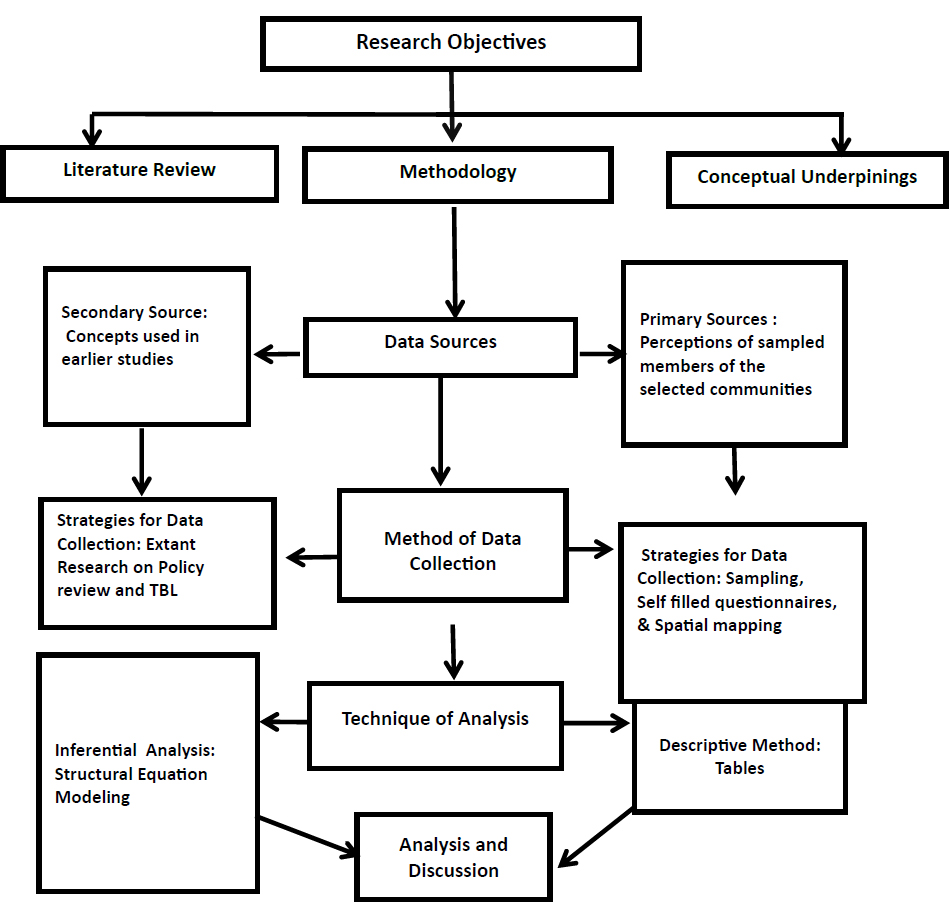
Study framework showing the graphical analysis of the study.
2. LITERATURE REVIEW
2.1. Regulatory Frameworks and Adherence to Standards as Catalysts to Sustainable Management of Port Ecosystem
The deployment of regulatory frameworks and adherence to established standards in exploring and utilizing natural resources are tactical tools against unjust and inefficient management of these resources [18-19]. Historical records indicated that a sharp increase in the exploration and utilization of natural resources globally towards the end of the last century has broad-gauged environmental consequences globally [18]. The nature of the diversified challenges includes governance issues, geopolitical tension over ownership rights, unsustainable exploitation of environmental assets, and the resultant rise in the deleterious impact of climate change on global societal health [18-20].
To address these anomalies, concerned stakeholders recognized the inevitability of having inclusive policies streamlined to meet the desires of different categories of stakeholders through which a secure and sustainable maritime environment can be created [18-20]. Scholars generally perceive regulatory frameworks as an established system of laws, rules, and regulations that structure and govern a particular industry, sector, or jurisdiction, providing clear standards for operation and ensuring compliance [21]. A holistic regulatory framework will be an omnibus that outlines the rights and obligations of individuals, businesses, and governments, and includes various components such as constitutions, statutes, administrative rules, policies, and judicial precedents to define boundaries and resolve disputes [8, 22-23].
The objective behind the formulation of such a framework is to promote public safety, ensure fair practices, protect consumers, and support the rule of law for natural resource management as they establish clear rules for resource ownership, use, and transfer, ensuring sustainable exploitation, fair distribution, and public safety [19]. They also provide a legal basis for governance, enabling governments to oversee resource development equitably, resolve conflicts between aborigines and investors, and attract investment, thereby promoting long-term economic development and preventing environmental damage or social unrest [1, 10, 23-26].
There have been no shortages of relevant frameworks to guide operations of all stakeholders in the maritime sectors [8, 18-20, 24-26]. The flagship of all these frameworks that provide an overarching guidance on the conservation and the sustainable utility of oceans, seas, and marine is Sustainable Development Goal 14 [27]. Scholars generally believed that the management of BE resources is implicitly or explicitly based on a cause-consequence-response framework that recognizes human activities as the ‘cause’ of negative environmental consequences that ultimately affect both the natural and societal systems [20, 28].
Stakeholders in the BE field believed that the availability of these policies has reduced the opacity of the global maritime sector's value chain and, through them, operational risks. For example, [9] a study designed a conceptual framework labeled as the Earth System Governance with five pillars of agency, architecture, inclusiveness, adaptiveness, and coherence, as an analytical framework to investigate the dynamics for institutionalising environmental sustainability policies in African ports. The work, an anecdotal research study, sought to assess how well the integration of BE thinking is constrained or enabled in selected ports across Africa.
Similarly, researchers [20] investigated the impact of International Maritime Organization (IMO) regulations on mitigating climate challenges in the shipping sector in Finland. The research employed the triangulation method and gathered data from actors actively involved in the day-to-day operations of sea transportation. The study evaluated the impact of regulations on reducing shipping’s negative impacts, particularly emissions, waste management, and noise pollution, under the umbrella of smart regulations. The results indicated that the current regulatory approach is neither comprehensive nor immediate, necessitating a more agile, digitally enabled framework to adapt to fast-changing industry conditions.
Cormier et al. [23] also thematically assessed the viability of the Multilateral Environmental Agreements (MEAs) framework as a governance tool for ocean and fisheries management, otherwise known as the Large Marine Ecosystems (LMEs) in China. Findings from the study indicated that the achievement of coherence in the implementation of governing instruments across the different categories of stakeholders on a regional basis was still inadequate. The study advocated increasing governance levels for LMEs and developing a synergistic framework with SDG 14.
In Nigeria, these regulations largely stemmed from the country's constitution and the incorporation of international maritime conventions like the International Convention for Safety of Life at Sea (SOLAS) by the International Maritime Organization (IMO) and the United Nations Convention on the Law of the Sea (UNCLOS) by the United Nations (UN) [29]. These conventions have been domesticated into Nigeria's maritime legal framework. This omnibus comprises key laws like the NIMASA Act, Merchant Shipping Act, Cabotage Act, and the Admiralty Jurisdiction Act, regulated by institutions including the Nigerian Maritime Administration and Safety Agency (NIMASA) and the Nigerian Ports Authority (NPA). This framework establishes maritime safety, security, and pollution control rules, and promotes indigenous participation by restricting domestic shipping to Nigerian vessels [29]. The Constitution vests authority in the Federal High Court for maritime disputes [30].
Literature search provides the globally acclaimed pre-defined indicators used to identify operational trends (otherwise known as the SOPs) linked to sustainability by seaports to include internal mechanisms to control resource utilization, energy use, waste management, and operational efficiency, which in turn affect environmental, economic, and social outcomes [31-32]. For instance, SOPs incorporating automation and predictive maintenance are designed to improve asset lifespan and reduce energy consumption. At the same time, other procedures may focus on reducing emissions, adopting renewable energy, managing water resources, and fostering community engagement to achieve the “triple bottom line” of sustainability [33-36]. The study affirms that the LDSP's management implements all these practices and that the members of host communities are generally aware of the SOPs.
An analysis of the available literature on discourse revealed that while there is unanimous belief among stakeholders on the import of an inclusionary policy to catalyzed the achievement of sustainability in marine resource exploration [9, 23, 37], studies that investigated the role that adherence to Standard Operating Procedures (SoPs), as a strategic approach to Sustainable Ocean Planning (SOP) that balances economic, social, and environmental needs of host communities that houses an innovative port facility are scarce. Therefore, this study contributes to the literature on the discourse by providing an empirical analysis that investigated the assessment of a smart port's compliance with policies stipulating the BE pillars of sustainable port development and responsible exploration of ocean resources in a developing economy.
2.2. Port Ownership/Governance Structures and the Deployment of Triple Bottom Line Principles in the Exploitation of Ocean Resources
Issues related to the Triple Bottom Line (TBL) in port development and management have grown in importance among industry stakeholders over the last few decades [38-44]. As conceptualized by experts, the TBL is seen as a sustainability framework that catalyzes a company's performance measures beyond traditional financial profit to include social (people) and environmental (planet) impacts. Historically, the TBL emerged as a more robust alternative to the traditional corporate reporting, which focused only on financial profit, and was coined by John Elkington in 1994 to advocate for a broader measure of corporate value [38, 43-46]. The theory gained traction among stakeholders in academia and the corporate world as a response to growing concerns about the negative social and environmental impacts of business, aiming to encourage companies to account for their social (people), environmental (planet), and economic (profit) performance. This fosters true sustainability and ensures long-term value creation, reassuring companies about their community's future, ecological footprint, and financial health [39].
Experience has shown that the deployment of TBL as a Key Performance Indicator (KPI) to assess port sustainability management varies across spatio-temporal divides and sometimes by other unique identifiers, such as port size and the level of Information Technology (IT) adoption [33, 47-48]. For example, evidence revealed that while larger ports routinely deploy environmental management tools such as TBL as part of the metrics used to assess their performance, such assessments are generally uncommon in smaller ports, with the cost of undertaking them widely considered a deterrent [47-50]. Also, the available literature is replete with evidence of the positive interactions between the deployment of IT and the achievement of port sustainability [48, 51-53]. Studies have shown that smart ports generally reported positive returns from green port solutions, such as balancing power supply, promoting alternative fuels, advancing a circular economy, and implementing waste management practices [54-55]. However, studies examining the nexus between port sustainability and ocean resource management, as measured by adherence to TBL metrics, are relatively scarce. This research filled this gap by providing insight into this underexplored area.
Available evidence suggests that the use of TBL metrics as a critical instrument in the management of natural resource exploitation across industries is influenced by ownership structure and a company's underlying philosophy, with publicly traded firms often facing greater pressure to adopt TBL due to regulatory and stakeholder scrutiny. At the same time, family-owned businesses may prioritize profit over sustainability unless it aligns with their long-term vision [56-58]. A literature search revealed evidence that business entities in sectors such as manufacturing and agro-allied industries often integrate TBL principles into their strategic goals, which are then reinforced by appropriate governance structures that align with their ownership values [56-60].
Evidence of relatable studies that interrogated the roles that port ownership structures, and the utility of TBL principles in the management of ocean resources to evaluate the crucial link between healthy marine ecosystems (environmental), sustainable livelihoods for fishing and coastal communities (social), and viable economic activities like sustainable fisheries and blue economies (economic) is scarce. Some of the few studies that examined the influence that port ownership/ governance structures exerted on port activities are limited to assessing their economic productivity and governance structures [61-62]. For example, De Langen [61] advocated diversifying port management from the centralized structure of State-Owned Enterprises (SOEs) to privately owned Port Development Companies (PDCs) to optimize their economic performance. Additionally, Wilmsmeier et al. [63] provided insights into Colombian ports' post-reform economic and institutional performances. The study advanced arguments on harmonizing governance structures between SOE and PDC. This research filled an important lacuna in this discourse by showing the interrelationship between the ownership structure of ports and the willingness to adopt and utilize TBL principles in the management of the LDSP's ocean-based resources.
3. HYPOTHESES DEVELOPMENT
On the basis of this extensive literature review, four hypotheses were formulated to establish the possibility of causal relationships between the exogenous variables (sustainable port development and responsible exploration of resources) and the identified endogenous variables (adherence to regulatory frameworks guiding the operations of the LDSP and compliance with the ports established SoP). This helped achieve the study’s objective. The formulated hypotheses are:
Hypothesis 1: Adherence to the established regulatory frameworks guiding the operations of ports significantly determines sustainable port development at the LDSP.
Hypothesis 2: Adherence to the established regulatory frameworks guiding the operations of ports significantly impacted the responsible exploitation of ocean resources at the LDSP.
Hypothesis 3: Compliance with the LDSP’s Standard Operational Procedure significantly influenced sustainable port development
Hypothesis 4: Compliance with the LDSP’s Standard Operational Procedure significantly determined responsible exploitation of ocean resources.
4. MATERIAL AND METHOD
To address the ethical considerations for this research, approval was sought from the Ethics Committee of Redeemer’s University, Ede, Nigeria. The approved ethical number is RUN/REC/2025/314. The research was conducted in line with the dictates of ethical approval, and the research team informed all respondents of their ethical rights before sampling. The researchers tried to ensure the strict confidentiality of all information from the respondents as outlined in the approved research protocol. This was done using code rather than respondents’ identities in data representation.
4.1. The Lekki Deep Seaport
The LDSP, built at USD 1.5 bn, is Nigeria’s first deepwater port, equipped to handle 1.2m standard containers annually; the LDSP was designed to strengthen Nigeria’s maritime transport position in West Africa. It was commissioned in 2023, and it has 13 cranes for a capacity of 2.5m twenty-foot equivalent units (TEUs) on a 1.2-km quay with a depth of 16 meters. It can process large cargo vessels with a capacity of up to 15,000 TEUs, previously diverted to other regional ports. The new facility is designed to help attract traffic destined for some of West Africa’s landlocked countries, such as Niger, Chad, and Mali, which have negotiated with the Nigerian Ports Authority (NPA) for the use of Lekki Port to transport goods to and from the country [64]. It is instructive that the new LDSP is touted as one of the top ten seaports in the African region in the coming years [1, 10]. The ownership structure of the Lekki Deep Sea Port is a Public-Private Partnership (PPP) with the Lekki Port Investment Holdings Inc. holding a 75 percent stake. The Lagos State Government has 20 percent, and the Nigerian Ports Authority (NPA) holds the remaining 5 percent. The investment consortium, Lekki Port Investment Holdings Inc., is a joint venture led by the China Harbour Engineering Company (CHEC) and the Tolaram Group, a Singaporean conglomerate. The LDSP operates under a Build, Own, Operate, and Transfer (BOOT) concession agreement.
4.2. Study Population/ Sampling Frame and Questionnaire Design
For this study, the target population constitutes the residents of the host communities of the LDSP (Fig. 2). These respondents are critical components of the study's quest to objectively analyze the assessment of smart port compliance with the BE pillars of sustainable port development and responsible exploration of ocean resources in a developing economy. They are also the most appropriate sources of information for achieving the study's objectives. A pre-field exercise was undertaken to get a working knowledge of the terrain of the study area and to unravel the best technique to apply for sampling the respondents. Multistage sampling is used to select the participants for the study.
The research instrument was a questionnaire that was divided into two major sections. The first section gathered data on the socio-demographic details of the respondents, while the second section provided information on the study’s core objectives that revolve around the characterizations of regulatory frameworks and operational procedures on the attainment of Blue Economy goals at the LDSP. Table 1 provides the breakdown of the derivation of the multivariate scales for both the endogenous and exogenous variables used in the study, along with the literature resources from which they are derived.
| S/N | Concepts Utilized in the Study | Application of Constructs/measurements | How Variables are Developed/used in Extant Studies | References |
|---|---|---|---|---|
| 1 | Regulatory Framework | Dependent variable | Assessment of the effectiveness of frameworks to capture policy implementation | [15, 19, 20-23, 25, 27-29, 31] |
| 2 | Standard Operating Procedure | Dependent variable | Key Performance Indicators (KPIs) fall into four main categories: berth performance, cargo handling, terminal and yard efficiency, and port safety and security. | [12, 31-32, 34, 37-41] |
| 3 | Sustainable Port Development | Independent variable | Economics metrics (financial performance). Environmental metrics (reducing pollution, improving energy use, protecting biodiversity), Social (community engagement, health and safety for workers, fair labor practices), | [39-41, 43, 46-47, 49] |
| 4 | Responsible Exploitation of Ocean Resources | Independent variable | SDG 14 (Life Below Water) and its subsets -reduce overfishing, marine pollution. Ocean Health Index | [51-53, 59-61] |
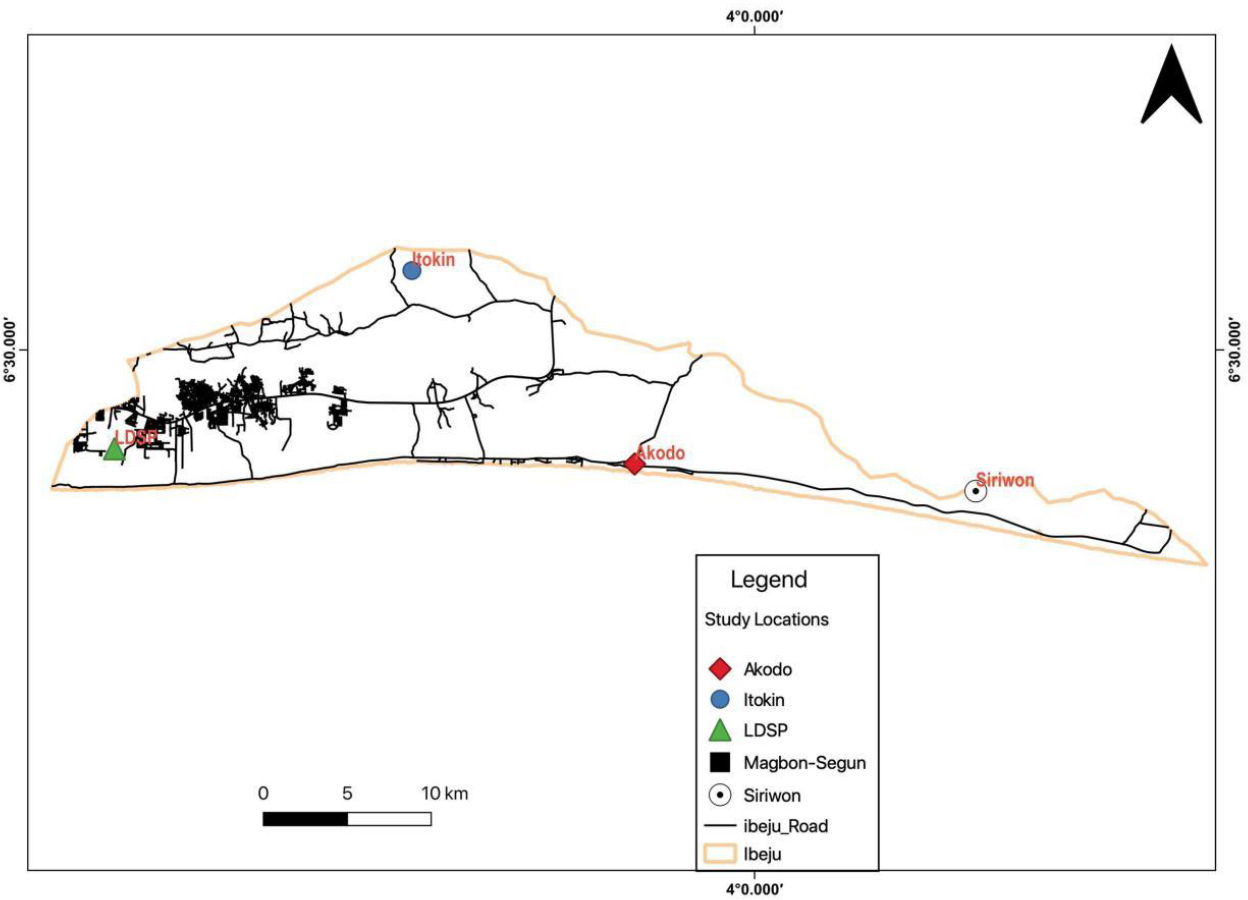
Map of Ibeju-Lekki local government area showing the study sites.
The statistical data in Table 2 give a breakdown of the population distribution of the host communities of the LDSP. The activities of the LDSP directly impact these communities. As earlier stated, their perceptions represent the views of critical stakeholders on how the port's activities (construction, operation, and management) have affected the livelihoods (as measured by the climate equity, environmental justice, and economic well-being) of the host communities. Their view also provides credible insights into the influences of the extant regulatory framework and the Standard Operating Procedure (SOP) deployed by the management of the LDSP on the attainment of the BE's pillars of sustainable port development and the responsible exploitation of ocean resources. The four communities that host LDSP are listed in Table 2; it should be noted that although the distances between these communities and the LDSP are not uniform, the residents are all affected by the port's construction and operations. They, therefore, represent the host communities. As indicated in Table 2 and Fig. (2), fifty-one thousand eight hundred forty-nine nineteen (51,849) residents represent the sample frame for the host communities.
| S/N | Name of Host Community | 2006 Population Figure (for adults) | 2024 Projected Population Figure |
|---|---|---|---|
| 1 | Magbon-Segun | 314 | 1419 |
| 2 | Shiriwon | 189 | 854 |
| 3 | Itoke | 764 | 3453 |
| 4 | Akodo | 10,204 | 46,123 |
| - | Total | 11,471 | 51,849 |
4.3. Sampling Method and Sample Size
The sampling frame broadly defines the total number of all the units in a given population under study. It is also a strong determinant of the structure or form through which an unbiased investigation can be made [65-67]. A reasonable sampling frame should satisfy the quality of being a fair representation of each identifiable element in a sampled population [65-67]. For this research, the multistage sampling technique was chosen. As stated earlier, the respondents who participated in this study are the members of the host communities that housed the LDSP. Four communities that shared boundaries fall into this category: Magbon-Segun, Itoke, Shiriwon, and Akodo (Fig. 2 and Table 2).
The multistage sampling technique selected two of the four listed host communities in Table 2. Residents of these two communities formed the expected population for this study. The two selected communities (Magbon-Segun and Itoke) are also the closest in distance to the LDSP facility, and it is expected that the activities of the LDSP will affect their livelihoods and liveability more than the other communities (Fig. 2). The pre-field exercise established that houses are arranged linearly as streets in these communities. In the second stage of the multi-level sampling technique, a simple random sampling technique selected every odd-numbered house as a study site; the household (landlord) or tenant was then selected as the main respondent to be interviewed.
Table 3.
| S/N | Names of Selected Communities | Population | Sampled Respondents |
|---|---|---|---|
| 1 | Magbon-Segun | 1419 | 131 |
| 2 | Itoke | 3453 | 305 |
| - | Total | 4872 | 436 |
The sample size for the respondents was determined using the statistical formula postulated by Yamane [66]. Yamane's formula analysis showed that 436 respondents will be sampled from the two communities. Hence, 436 copies of the questionnaire were produced and administered to the members of the two communities selected for the study. A simple proportion was applied to the distribution of the research instrument between the two communities (Table 3). Since the Magbon-Segun community accounts for 30% of the population, 131 respondents were sampled from the community, while the remaining 70% (305) were sampled from the Itoke community. At the second stage of selecting respondents for the study, a simple random sampling was used. The pre-field exercise showed that houses are arranged in a linear street-like pattern in the two communities; based on this, every odd-numbered house was selected for the study. Collected data from the fieldwork exercise were processed and analysed through IBM SPSS 22.0 and Smart-3 PLS software.
5. RESULTS
5.1. Analysis of the Demographic Structure of Respondents and LDSP Influence on Triple Bottom Line Goals
From the 436 distributed questionnaires, 375 (86 percent) were retrieved and used for the analysis.
Table 4 provides the demographic analysis of the distributed questionnaires. The age distribution shows that the bulk of the population, 304 (81.07 percent), is between 21 and 40 years old, a figure consistent with the national census, which reports that over 90 percent of Nigeria’s population is 40 years old and below [67]. Two hundred fifty-three (67.46 percent) of the sampled respondents were household heads, with the preponderance of the sampled population being households, which is an immense advantage because they are in a position to provide meaningful responses to the questions. All the respondents are educated; although 202 (53.86 percent) had a primary school leaving certificate, the fact that virtually all respondents are educated indicates that they generally understood the objectives of the study. Similarly, a bulk of the respondents are aborigines, 203 (54.13 percent), which is propitious to the study’s objectives, as these respondents were able to provide the needed information. Most of the respondents posit that the presence of the LDSP has helped in the achievement of the economic dimension of the Triple Bottom Line (TBL) sustainability goal, 275 (73.33 percent), which is more than two-thirds of the respondents affirms the economic benefits of the port, whereas a paltry 35 (9.34 percent) identified with the environmental contributions of the ports. When an enquiry was made on the influence that the ownership structure of the LDSP has on the utilization of TBL principles in the management of ocean resources, 289 (73 percent) of the respondents affirmed that they perceived that the ownership structure of the LDSP positively influenced the management adoption of TBL principles in the exploitation of the ocean-based resources. On the other hand, 89 respondents (23 percent) believed that the ownership structure had no bearing on the deployment of TBL principles to exploit ocean-based resources.
5.2. Inferential Analysis
Residents of the host community provide the response data for the variables in the stated four hypotheses, and the Structural Equation Model (SEM) was used to specify the links among them. The SEM has proven to be a robust statistical technique for testing complex hypotheses involving latent variables and their relationships [68-70]. It is also ideal for providing intelligible analyses of variables in complex interrelationships, while accounting for measurement errors and common method variance, as done in this study [71].
| Demography | Classifications | Frequency | Percent |
|---|---|---|---|
| Age | 21-30yrs | 213 | 56.81 |
| 31-40yrs | 91 | 24.26 | |
| 41-50yrs | 40 | 10.66 | |
| 51-60yrs | 21 | 5.61 | |
| 61-65yrs | 10 | 2.66 | |
| Marital Status | Single | 255 | 68.00 |
| Married | 110 | 29.33 | |
| Separated | 8 | 2.13 | |
| Divorced | 1 | 0.27 | |
| Widowed | 1 | 0.27 | |
| Position | Household Head | 253 | 67.46 |
| Chief | 23 | 6.13 | |
| Member | 69 | 18.40 | |
| Others | 30 | 8.01 | |
| Education | Primary School Cert. | 202 | 53.86 |
| SSCE | 85 | 22.66 | |
| ND/NCE | 23 | 6.14 | |
| BSc/BA/HND | 14 | 17.34 | |
| Years of Residence | 1-5yrs | 147 | 39.20 |
| 6-10yrs | 89 | 23.73 | |
| 11-15yrs | 70 | 18.66 | |
| 16yrs and above | 69 | 18.41 | |
| Stake in Community | Aborigine | 203 | 54.13 |
| Non-native | 172 | 45.87 | |
| Contributions of LDSP to Triple Bottom Line Goals of the Port Environment | Environmental | 35 | 9.34 |
| Economical | 275 | 73.33 | |
| Social | 62 | 16.53 | |
| Influence of Ownership Structure on the Utilization of TBL in the Management of Ocean Resources | Positive | 289 | 77 |
| Influence of Ownership Structure on the Utilization of TBL in the Management of Ocean Resources | Negative | 86 | 23 |
| Valid | Total N | 375 | 100 |
5.2.1. Assessment of the SEM Results
Table 5 reveals the model assessment results of the structural model. The factor loading requirement was a minimum acceptable value of 0.6, and only items that met this condition were retained for the path analysis. The retained indicators are listed in Table 5 and are considered fit to measure their respective constructs. Furthermore, the Cronbach's alpha statistics indicate that all constructs exceed the minimum acceptable threshold of 0.6. In addition, the composite reliability statistics show that hat the variables have no reliability problem, since their values are all above the 0.6 benchmark. The authors wish to draw attention to the Cronbach's alpha of 0.66 for the “Regulatory Framework” construct, which is slightly below the conventional threshold of 0.7. Analysts generally believed that such a figure is acceptable for early-stage or exploratory research, a situation that is relevant to the present study [25, 28, 31]. These establish that all the items to a reasonable extent are reliable in jointly measuring their respective constructs.
Lastly, the Average Variance Extracted (AVE) was also computed to assess the convergent validity of the constructs, and the results in Table 5 indicate that all constructs have values above the minimum acceptable threshold of 0.5.
5.2.2. Discriminant Validity for SEM of the Variables
The Fornell-Larcker and Heterotrait-Monotrait (HTMT) criteria were used to assess the discriminant validity of the construct variables, and the results are presented in Tables 6 and 7, respectively.
Table 5.
| Construct | Indicators | Loadings | Cronbach's Alpha | Composite Reliability | Average Variance Extracted (AVE) |
|---|---|---|---|---|---|
| Regulatory Framework | RF-1 | 0.862 | 0.66 | 0.816 | 0.598 |
| RF-2 | 0.753 | - | - | - | |
| RF-4 | 0.695 | - | - | - | |
| Standard Operating Procedure | SOP-1 | 0.823 | 0.788 | 0.864 | 0.617 |
| SOP-2 | 0.837 | - | - | - | |
| SOP-3 | 0.83 | - | - | - | |
| SOP-4 | 0.634 | - | - | - | |
| Sustainable Port Development | SPD-1 | 0.764 | 0.815 | 0.878 | 0.642 |
| SPD-2 | 0.776 | - | - | - | |
| SPD-3 | 0.852 | - | - | - | |
| SPD-4 | 0.812 | - | - | - | |
| Responsible Exploitation of Ocean Resources | REO-1 | 0.775 | 0.833 | 0.888 | 0.665 |
| REO-2 | 0.896 | - | - | - | |
| REO-3 | 0.773 | - | - | - | |
| REO-5 | 0.812 | - | - | - |
| - | Regulatory Framework | Responsible Exploitation of Ocean Resources | Standard Operating Procedure | Sustainable Port Development |
|---|---|---|---|---|
| Regulatory Framework | 0.773 | - | - | - |
| Responsible Exploitation of Ocean Resources | 0.431 | 0.816 | - | - |
| Standard Operating Procedure | 0.257 | 0.551 | 0.786 | - |
| Sustainable Port Development | 0.383 | 0.562 | 0.637 | 0.801 |
| - | Regulatory Framework | Responsible Exploitation of Ocean Resources | Standard Operating Procedure | Sustainable Port Development |
|---|---|---|---|---|
| Regulatory Framework | - | - | - | - |
| Responsible Exploitation of Ocean Resources | 0.603 | - | - | - |
| Standard Operating Procedure | 0.403 | 0.650 | - | - |
| Sustainable Port Development | 0.516 | 0.636 | 0.769 | - |
The Fornell-Larcker criterion requires that the square root of the AVEs (bolded values) must be greater than the inter-construct correlations (unbolded values). The results in Table 6 show that this has been satisfied. Also, none of the HTMT ratios in Table 6 exceed the maximum threshold of 0.9, indicating that the construct variables lack discriminant validity.
5.2.3. Analysis of the Model Fit for SEM
Table 8 presents the goodness-of-fit results for the SEM. The Standardized Root Mean Residual (SRMR) for the model is 0.127, which is above the maximum acceptable benchmark of 0.08. It should be noted that the SRMR value of 0.127 exceeds the ideal benchmark; this can be attributed to the model's complexity, as evidenced by the numerous variables it contains. However, the model fit indices (d_ULS = 1.724 & d_G = 1.046) are both within their maximum acceptable benchmarks (HI95 = 1.74 & 1.27, respectively). In addition, the R-squared values of 0.393 and 0.457 suggest that the explanatory variables (regulatory framework and standard operating procedure) jointly account for the variations in the exploratory variable (responsible exploitation of ocean resources and sustainable port development). Overall, the results indicate a good model fit for the SEM.
Figure 3 shows the analysis of the hypothesized paths for objective four. The regression results of the path relationships are also specified.
| Criteria | Estimated Model | Benchmark |
|---|---|---|
| SRMR | 0.127 | < 0.08 |
| d_ULS | 1.724 | <HI95=1.74 |
| d_G | 1.046 | <HI95=1.27 |
| Chi-Square | 1017.651 | - |
| R-squared (REO) | 0.393 | - |
| R-squared (SDP) | 0.457 | - |
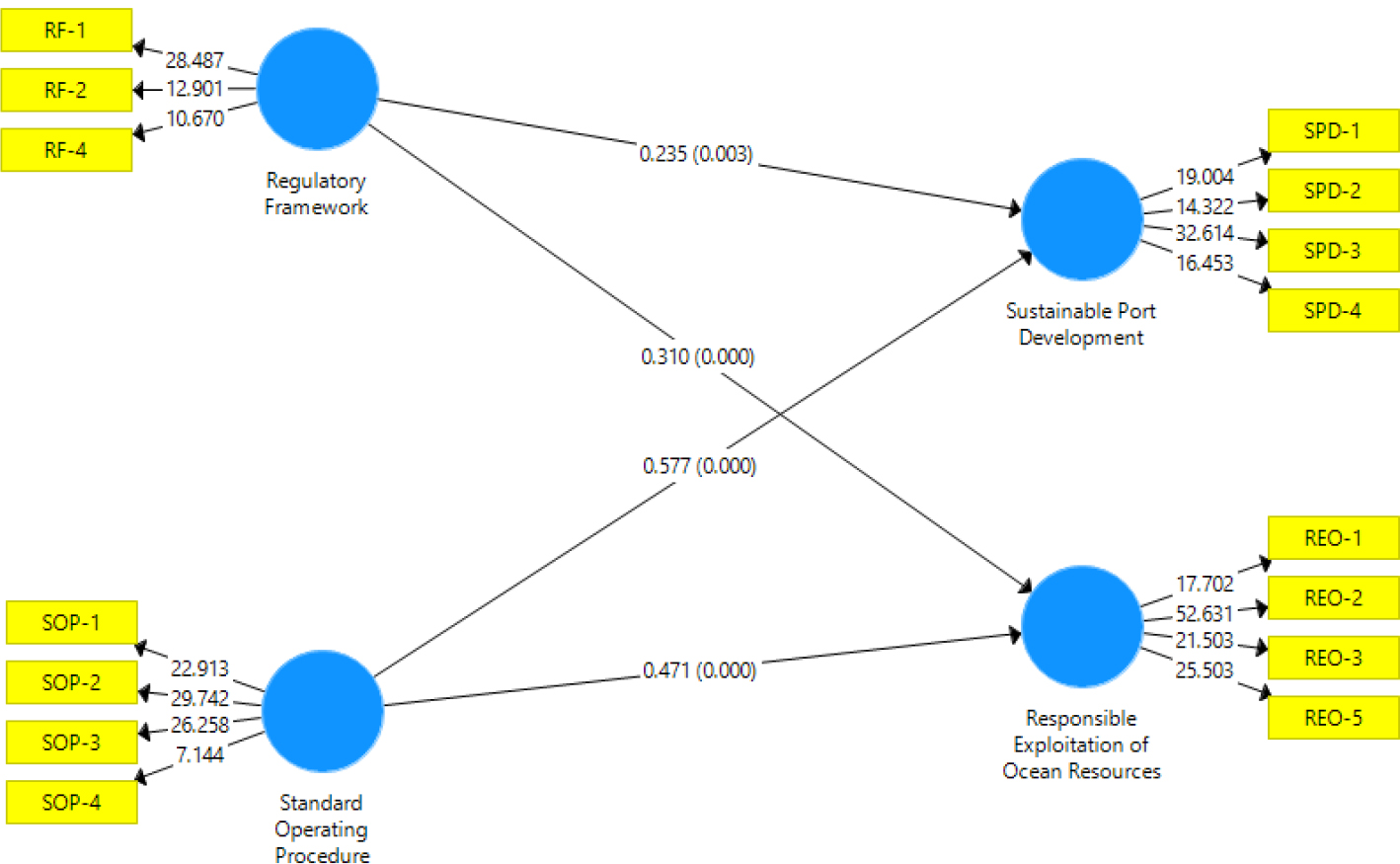
Path diagram for the SEM in the study’s objective.
Source: Smart PLS-4 (2025).
The results of the path analysis show that the path coefficient from ‘Regulatory Framework’ to ‘Sustainable Port Development’ is positive (β1=0.235), indicating a direct relationship. The t-statistic for this path (t = 2.967), as indicated in Table 9 and Fig. (3), is statistically significant at the 5% level (p = 0.003). Therefore, it is concluded that the implementation of the extant regulatory framework by LDSP directly and significantly influences their sustainable port development.
| Hypothesized Paths | Beta | Mean | Standard Deviation | t-statistics | p-values |
|---|---|---|---|---|---|
| Regulatory Framework -> Sustainable Port Development | 0.235 | 0.242 | 0.079 | 2.967 | 0.03 |
| Regulatory Framework -> Responsible Exploitation of Ocean Resources | 0.310 | 0.317 | 0.065 | 4.741 | 0.00 |
| Standard Operating Procedure -> Sustainable Port Development | 0.577 | 0.584 | 0.058 | 9.937 | 0.00 |
| Standard Operating Procedure -> Responsible Exploitation of Ocean Resources | 0.471 | 0.473 | 0.048 | 9.827 | 0.00 |
Similarly, the path coefficient from ‘Regulatory Framework’ to ‘Responsible Exploitation of Ocean Resources’ is positive (β2=0.31), indicating a direct relationship. Also, the t-statistic of this path (t = 4.741) as shown in Table 9 is statistically significant at the 5% level (p=0.00). Hence, it is concluded that the implementation of the extant regulatory framework by LDSP directly and significantly influences the responsible exploration of ocean resources.
Further results show that the coefficient of the path from ‘Standard Operating Procedure’ to ‘Sustainable Port Development’ is positive (β3 = 0.577), suggesting a direct relationship. The t-statistic of this path (t = 9.437) is statistically significant at the 5% level (p=0.00). Therefore, it is concluded that the implementation of the standard operating procedure by LDSP directly and significantly drives sustainable port development.
In addition, the coefficient of the path from ‘Standard Operating Procedure’ to ‘Responsible Exploitation of Ocean Resources’ is positive (β4 = 0.471), indicating a direct relationship. The t-statistic of this path (t = 9.827) is also statistically significant at the 5% level (p=0.00). Hence, it is concluded that the implementation of standard operating procedures by LDSP directly and significantly impact responsible exploitation of ocean resources.
6. DISCUSSION
The main objective of this study is to investigate how the implementation of the regulatory framework and the SOP has influenced the sustainable management of the port environment and the marine resources of the Lekki Deep Seaport (LDSP), based on the perceptions of the residents of the LDSP's host communities.
The use of community perceptions as tools for the assessment of port sustainability and ocean resource management has become popular in contemporary studies because it fosters collaboration, enhances security and safety by involving key stakeholders, and ensures that management strategies are relevant and practical for the community's needs and well-being [35, 72-77]. Experience has shown that inclusionary studies engender greater responsibility among all stakeholders, economic empowerment, and environmental protection, and ultimately create a competitive advantage for the port through improved community relations [12-15, 35, 75-76].
Results of the SEM that tested the derived hypotheses affirmed that there are elements of predictability in the relationships between the identified endogenous and exogenous variables. In specific terms, the results (Table 9 and Fig. 3) indicated a statistically significant relationship between adherence to established regulatory frameworks guiding port operations and achieving sustainable port development at the LDSP. Similarly, Table 9 and Fig. (3) results also affirmed the likelihood of causality between compliance with regulatory frameworks operational at the LDSP and the responsible exploitation of ocean resources. These results validate findings from earlier studies with similar slants and contribute to this body of knowledge by providing an empirical analysis of the situation of a newly constructed automated port in a developing economy [12-18]. Additionally, the results of the third and fourth hypotheses indicated that the deployment or utilization of the SOPs by the management of the LDSP significantly impacted the attainment of the goal of sustainable port development and responsible exploitation of ocean resources (Table 9 and Fig. 3) [42-45].
The study also examined the influence that the ownership structure of LDSP exerted on the adoption of the TBL principles for the responsible exploitation of ocean resources in the study area (Table 4). Experiences have shown that daily port routines like pollution from oil/fuel spills, and discarding of waste from cleaning operations, improper disposal of organic waste, and damaged products into the sea; and the disruption of habitats from port construction and dredging activities exacerbate difficulties associated with the responsible ocean resource exploitation of ocean resources [16-18, 38, 45-49, 53, 72].
While this research can not be referred to as an exploratory work on the confluence between adherence to legal frameworks and SOPs guiding seaports operations and the attainment of sustainability goals and responsible exploitation of ocean resources. It contributes to the available literature in the discourse by offering new insights through a contextual analysis from a developing-world perspective. Most earlier studies on the discourse emanated from the developed economies of the Western world [37, 73-76].
This present work has also extended the frontier of knowledge on the discourse by revealing the mindsets of the host communities housing the LDSP on the contributions of the studied port to the attainment of the TBL goals (Table 4) [42-45]. While there is apparent congruence in affirming that the port's operations have helped attain the TBL goals in the communities, it is instructive that there are considerable disparities in agreement on the specific goal that residents have benefited mostly from [42-45]. Nearly 75 percent of respondents affirmed that they had benefited more from the economic dimension than from the other two (environmental and social).
Evidence from available research indicates that business owners in other industries tend to prioritize the economic dimension of the TBL at the expense of the environmental dimension [43, 77-78]. It has been advocated that business owners/managers can be barking up the wrong tree through such decisions, as it can lead to severe consequences, including the depletion of natural resources, increased pollution, and disruptions to ecosystems, ultimately undermining long-term economic viability [78]. This imbalance can also negatively impact social well-being, create resource conflicts, and erode a company's reputation, as environmental degradation costs society [43, 76-79].
Findings from the study indicated that an overwhelming majority of respondents (73 percent) believe that the ownership structure of the LDSP positively influenced the adoption of the TBL principles in the exploitation of ocean resources. Obviously, the ownership structure is a key factor, as it increases confidence and lets the investors feel that their interests are important and appreciated in port management dynamics. The LDSP is managed under a PPP arrangement, with the private sector holding 75 percent of the stakes, a significant majority of the holdings. Experience has shown that private PDCs adhered more to the best global practices in port management than SOEs [61-62]. A literature search also indicated that other underlying drivers, such as pressure from private investors to maintain a continuous flow of Return-on-Investment (ROI), often lead to the prioritization of economic goals over environmental and social goals [59-62].
Policy makers can take a cue from this in pushing for increased private-sector involvement in managing the country's existing ports.
7. THEORETICAL CONTRIBUTIONS
This present study contributed to theory-building in maritime research by providing, through an exploratory case study, a valuable opportunity to understand the intersection between port ownership structure, attainment of TBL goals, and their impact on the overarching desire to achieve BE growth in the study area. Findings from this research also highlighted, through both statistical and contextual analyses, the possibility of testing the effectiveness of extant operational and regulatory governance models in port management [18-21]. By linking port growth to their TBL outcomes, particularly in host communities, this research has extended the frontier of the original TBL theoretical constructs by offering new perspectives and a deeper understanding of the complex relationships between private investors and host communities through the theoretical lenses of TBL and BE. The novel application of the TBL and BE frameworks in this regard helps broaden the horizon of the port management ecosystem by providing data-driven insights into the relationship between governance structures and performance outcomes, ultimately enabling policymakers and port authorities to make informed decisions.
8. MANAGERIAL IMPLICATIONS AND FUTURE DIRECTIONS OF RESEARCH
The present research has some limitations. The first is that the LDSP is relatively young (less than 3 years old) at the time of this study, and while this does not undermine the validity of the findings, a study with a similar slant is advocated when the port is older (maybe a decade old). Findings from such a study will reveal the management of the LDSP's adherence to the frameworks and structures currently in place at the port. Second, this study chose members of the host communities as the respondents. However, future research could involve the LDSP's employees and clients as respondents. Future research directions should also be expanded to include longitudinal studies that can provide deeper insight into how BE goals can be sustainably achieved, offering intriguing possibilities for further research.
CONCLUSION
In conclusion, this research provided an opportunity to empirically assess how the implementation of regulatory frameworks and operational procedures by the LDSP's management has affected the attainment of BE goals, as perceived by the residents of the study area. It also offers insights into how modern seaport operations influence livelihoods in developing economies, broadening the understanding of port-community interactions.
AUTHORS’ CONTRIBUTIONS
The authors confirm their contribution to the paper as follows: J.P.M.: Study conception and design; A.B.I.: Conceptualization; A.O.O.: Investigation; I.P.O.: Data collection; O.D.O: Analysis and interpretation of results; A.A.: Draft manuscript. All authors reviewed the results and approved the final version of the manuscript.
LIST OF ABBREVIATIONS
| AVE | = Average Variance Extracted |
| BE | = Blue Economy |
| BOOT | = Build Own Operate Transfer |
| CHEC | = China Harbour Engineering Company |
| IBM | = International Business Machine |
| IMO | = International Maritime Organization |
| IT | = Information Technology |
| KPI | = Key Performance Indicator |
| LME | = Large Maritime Ecosystem |
| LDSP | = Lekki Deep Sea Port |
| MEA | = Multilateral Environmental Agreement |
| NPA | = Nigeria Port Authority |
| NIMASA | = Nigeria Maritime Administration and Safety Agency |
| PDC | = Port Development Company |
| PPP | = Public-Private Partnership |
| SDG | = Sustainable Development Goals |
| SEM | = Structural Equation Model |
| SOE | = State Owned Enterprise |
| SOLAS | = International Convention for Safety of Life at Sea |
| SOP | = Standard Operating Procedure |
| SPSS | = Statistical Package for Social Sciences |
| TBL | = Triple Bottom Line |
| TEU | = Twenty Foot Equivalent Units |
| UN | = United Nations |
| UNCLOS | = United Nations Convention on the Law of the Sea |
| USD | = United States Dollar |
ETHICS APPROVAL AND CONSENT TO PARTICIPATE
An approval was sought from the ethical committee of Redeemer’s University, Ede, Nigeria. The approved ethical number is RUN/REC/2025/314.
HUMAN AND ANIMAL RIGHTS
All procedures performed in studies involving human participants were in accordance with the ethical standards of institutional and/or research committee and with the 1975 Declaration of Helsinki, as revised in 2013.
AVAILABILITY OF DATA AND MATERIALS
All data generated or analyzed during this study are included in this published article.
ACKNOWLEDGEMENTS
Declared none.