All published articles of this journal are available on ScienceDirect.

Integration of Goods and Passenger Transportation in Rural Areas: A Review
 iD
Tiziana Campisi1
iD
Giovanni Tesoriere1
iD
Muhammad Ahmad Al-Rashid2
iD
iD
Tiziana Campisi1
iD
Giovanni Tesoriere1
iD
Muhammad Ahmad Al-Rashid2
iD
Authors Info & Affiliations
Abstract
Problems of sustainable development in rural areas are highlighted in the context of Sustainable Development Goals. Both Goal 9 and Goal 11 refer to the accessibility of infrastructure and public transport systems. Passenger and freight transport often lack adequate infrastructure and services in rural areas, typically characterized by lower population density and greater territorial dispersion. Integrating passengers and goods flow through scheduled or on-demand services is crucial to reducing territorial gaps. Services like Demand Responsive Transport (DRT), with its logistics aspects and other passenger-goods integration services, are well-suited to contexts with weak transport demand situations that can lead to potential social exclusion and demand niches not covered by traditional public transport. This research presents a general overview to assess some of the main applications of passenger-goods integration services in rural contexts. An evaluation of the current state of the literature on integration between passenger and goods transportation, available in scientific databases (Scopus, ScienceDirect, Web of Science, and IEEE Xplore), is performed. 18 contributions were in-depth analyzed through a geographical and temporal classification, focusing on several aspects, including the methodologies adopted, types of services, and classification of study areas. The study reveals a growing interest in the topic, with 10 contributions published in 2023 alone. Most of these contributions originate from China and Japan, respectively, 7 and 3 of them. Additional contributions come from several European countries, especially Sweden and Italy. The research findings highlight the growing interest in this topic in the scientific literature, underscoring the planning and implementation of combined transport services in line with the goals of the Green Deal and Agenda 2030, and considering methodologies from Transportation Systems Models.
1. INTRODUCTION
As of 2023, approximately 42.66% of the world's population is estimated to live in a rural context [1]. Even in the most industrialized countries, it is clear that the percentage of the non-urbanized population is significant: in the European Union in 2021, 25.2% of total residents were identified as residing in rural areas [2]. In the USA, 17% according to the 2010 census [3], and approximately 33% of the population in China in 2023 reside in rural areas [4]. It is essential to consider that residents in rural areas often face disadvantages in accessing services. Cities, especially the large conurbations of the 21st century, represent formidable centers of attraction, such as schools, hospitals, workplaces, and places of entertainment, drawing more people to these locations, a process that has been ongoing for several centuries, beginning with the Second Industrial Revolution [5].
It is essential to recall the objectives of the United Nations, expressed in the document “Transforming our World: The Agenda 2030 for Sustainable Development” [6]. The primary purpose of the United Nations' Sustainable Development Goals is to reduce global inequalities. Many Goals and related targets emphasize the need to reduce disparities between urban and rural areas. The differentiation between urban and rural residents is equivalent to socio-demographic divisions by gender, age, and occupation, as mentioned in Goals 1 and 4. Indicator 9.1.1 (Proportion of the rural population who live within 2 km of an all-season road) refers to accessibility to main roads by residents of rural areas. Target 11 on Sustainable Cities and Communities is also primarily involved in improving the sustainability of transportation systems. As an example, Target 11.2 states “By 2030, provide access to safe, affordable, accessible and sustainable transport systems for all, improving road safety, notably by expanding public transport, with special attention to the needs of those in vulnerable situations, women, children, persons with disabilities and older persons”. Additionally, Target 11.a is essential, recalling the role of connecting urban and peri-urban areas with rural areas: “Support positive economic, social, and environmental links between urban, peri-urban, and rural areas by strengthening national and regional development planning”. Even targets on climate change like the 13.2 “Integrate climate change measures into national policies, strategies and planning” and energy efficiency like the 7.3 “By 2030, double the global rate of improvement in energy efficiency” may be involved, even if they do not explicitly refer to rural transportation [7].
The importance of connectivity between rural and urban areas is highlighted. Rural areas are characterized by low population density [8] and scattered residential agglomerations; therefore, they experience difficulties in being hubs for aggregating services. Furthermore, low population density often renders traditional public transport systems based on systematic service provision inefficient [9].
The high average age of rural communities in much of the world, especially in less developed countries [10], combined with the previous reasons, often isolates urban communities and reduces their accessibility [11]. The issue of the inclusion of rural areas is, above all, a social issue. Recent studies on rural transport and social sustainability present a rich body of work, documenting how mobility systems influence social exclusion, transport justice, and the overall well-being of communities [8, 12, 13].
A growing number of studies demonstrate that gaps in transport provision or poor accessibility can exacerbate structural disadvantages for specific social groups. Evidence from different contexts reinforces these findings. Shergold & Parkhurst [14] identify rural car dependence as a critical barrier to participation in community activities among older residents. At the same time, Gray et al. [15] examine the complex interplay between community transport, social capital, and exclusion in sparsely populated areas. At a more theoretical level, a study by Lucas [16] offers comprehensive frameworks for analyzing transport and social exclusion, which remain highly relevant for contemporary research and the design of inclusive transport strategies.
Flexible services, such as Demand Responsive Transport (DRT), have characteristics of frequency that are intermediate between conventional buses and taxis [17]. These services help mitigate the inefficiencies of traditional public transport resulting from reduced demand, while simultaneously guaranteeing the connection services required by the community, thereby highlighting the social dimension of these services. Their role services are repeatedly mentioned in the literature regarding connections with rural communities [18-20]. European studies have highlighted the success factors for DRT in rural areas, suggesting above all that service operators operate on a large scale to exploit economies of scale [21].
A study by Enoch et al. [22] highlighted several critical issues of DRT, distinguishing these services into four categories based on their ability to survive. The authors place rural transport in the third category (justifiable higher subsidy DRT), thus underlining the contribution of public subsidy and, therefore, the nature of reducing inequalities within the DRT.
The complementary sector is the freight sector, particularly in relation to last-mile deliveries. Compared to urban last-mile delivery, the rural environment presents different issues. The larger areas involved, the greater distance between delivery nodes, and the reduced quantity of products ordered make rural last-mile logistics less efficient than urban logistics [23].
A solution to the various problems, which allows for the reduction of the accessibility gap and the improvement of the delivery service efficiency, is represented by the integration of services between passenger transport and freight transport. These services often arise from the combination of on-demand services with elements of last-mile delivery [24].
A general overview of these services, accompanied by an exploration of the relevant literature, is the primary argument of this work. The main advantages offered by these integrated services, and their role within Agenda 2030, are examined. This research aims to identify the works produced in the literature on the topic and understand which elements are most recurring in terms of sustainability in the implementation of these services.
Despite growing interest in integrated passenger and freight transport services, particularly in rural areas, the existing literature remains fragmented and characterized by heterogeneous terminology, methodological approaches, and evaluation criteria. Previous studies often focus on individual aspects without providing a comprehensive and systematic perspective on their integration and sustainability implications. As a result, a consolidated overview that can identify common research trends, methodological frameworks, and sustainability outcomes remains weak.
This research provides a general overview of these tools for integrating goods delivery and flexible passenger transport in rural areas. The goal is to identify the main general contributions present in the literature, recognize the contributions that address, across the literature, the issues of on-demand transport in the passenger sector, the integration between passenger and freight transport, and transport in rural areas.
This paper addresses this research gap by providing a structured literature overview of integrated passenger–freight transport services in rural areas. The study contributes by classifying existing works according to temporal and geographical dimensions, service characteristics, sustainability objectives aligned with the Agenda 2030, and the use of Transportation System Models (TSM) [25-27] encompassing demand, supply, and assignment components. Through this approach, the paper identifies prevailing research directions, methodological gaps, and underexplored areas, thereby supporting future research and policy development in sustainable rural transport systems.
The research aims to define and identify the main contributions, highlighting current developments, unexplored potential, and areas of research that have not been explored in depth.
The need to carry out this study arises mainly from five questions:
- RQ1: When were the works considered published, and whether temporal trends emerge.
- RQ2: Which are the geographical areas that are driving research on the topic studied, and which are the geographical areas most interested in applications?
- RQ3: What services are provided?
- RQ4: What is the real impact, actual or expected, of these methodologies, in terms of environmental, economic, and social sustainability?
- RQ5: Which particular lines of research emerge, with differences in terms of the methodologies adopted?
The research questions are summarized in Fig. (1).
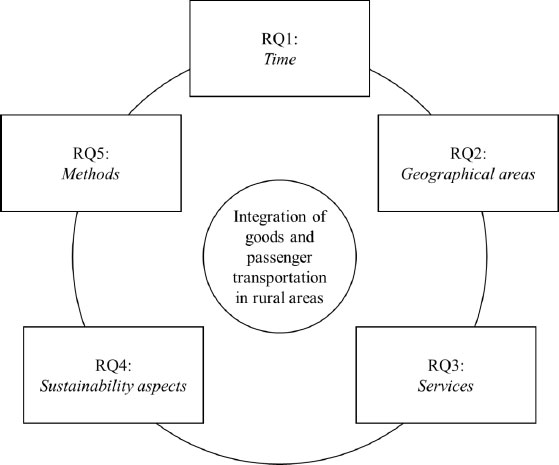
Research questions posed.
2. LITERATURE REVIEW
The main existing overall contributions on the topic are presented. Integrating passenger and freight transport in rural areas has received significant consideration from the scientific literature in recent years. It is helpful to analyze some critical works that deal with this topic, even if only partially, or in contexts other than rural ones. The authors classify the works by specifying their essential characteristics. Two categories are distinguished: Literature Review, which defines the work as carried out through schematic analyses according to bibliometric criteria, and General Overview, in which the work shows or compares case studies and applications. A baseline of literature is provided. Recalling the study proposed by Li et al. [28], there is a notable heterogeneity in the definitions indicated in the literature. Several terms may refer to similar concepts:
- Share-a-ride, which usually refers to the possibility of using the same vehicle for passengers who must travel part of the journey together, but which is also extended to the transport of passengers and parcels on the same vehicle [29].
- Co-modality, which generally refers to the use of alternative modes for increasing the efficiency and sustainability of transport systems, is used to describe the possibility of combining elements of passenger and freight transport [30, 31].
- Collaborative freight and passenger transportation, which refers to the possibility of making the system more efficient by combining and integrating passenger and freight transport services [32].
- Demand Responsive Transport and Logistics refers explicitly to the combined use of DRT passenger and logistics services [33].
Even a concept such as Mobility-as-a-Service (MaaS) can encompass elements that refer to the integration of passenger and freight transport [34-37]. In the subsequent steps of the work, the expression “integrated passengers and freight transportation” was used to describe the problem in general; other terms were used only if specifically indicated by the reference literature. In the study of potential niches interested in DRT services, the literature mentions connections between rural communities and rural hoppers [38]. The difference in density compared to urban areas represents a good opportunity to apply unscheduled services; often, these services cannot replace but complement scheduled services [39].
DRTs are among the innovative transport modes analysed by [40] in one of the first Systematic Literature Reviews (SLRs) on the topic. In rural areas, several aspects have been considered: DRT has a role in reducing inequalities [40-42] and in improving the integration of services [43]; they are perceived as a mode of transport mainly linked to older adults [44]; they can serve to improve rural connectivity [45-47]. Furthermore, DRTs can also be used as an element that complements existing conventional public transport [48].
The literature suggests that, among the emerging possibilities, DRT may be used as a feeder system between peripheral users and the central hubs of the transport system or the activity system [49].
The application of passenger DRT services in Europe is widespread and often connected to rural areas [50]. However, the advantages highlighted in the literature are compared with a still immature system and a considerable failure rate of the projects [51]. Despite the contributions of the literature, which indicate that many DRT services are oriented towards passenger transport in rural areas, the prevailing dimension of application of these services remains urban [52].
Freight transport in rural areas is also a significant issue. Given the exponential growth of e-commerce in recent years [53], parcel freight transport has also experienced an increase, even in rural areas, where it faces structural challenges. Low demand density, long delivery distances, and limited logistics infrastructure are elements that often lead to high costs and environmental impacts. In rural areas, conventional urban logistics models are inefficient. There is a need for alternative and more flexible delivery solutions, including consolidation strategies, shared logistics resources, and demand-responsive systems. In this context, the integration of parcel delivery with passenger transport services has been increasingly investigated as a promising approach to improve vehicle utilization, reduce emissions, and enhance service accessibility in rural and peripheral areas [53-61]
Integrated passenger-freight transportation is a widely studied topic in the urban context [62]; however, fewer contributions address specific analyses of the rural aspect. [63] proposes a short literature review of case studies of passenger-freight transport integration in rural contexts. Integrated passenger-freight transport is a lever that can reduce inefficiencies in rural contexts and improve aspects related to environmental, social, and economic sustainability [64, 65].
Among the contributions indicated are several literature reviews. It is beneficial to recall the keywords used by these SLRs. In particular, in a study by Parmaksız et al. [65], the topics searched are Rural Logistics AND Rural Transportation and Rural Logistics AND Rural Transportation AND Sustainability; El Amrani et al. [62] conducted the search starting from different combinations of “Urban Freight/Logistics” terms and “Public Transportation” terms; Butler et al. [40] made the search considering a combination of terms relating to a “smart mobility innovations” term and a “transport disadvantage” term. The analyzed contributions are significant and demonstrate substantial attention to the topic in recent years. Already at the first level, the level of analysis of works in literature, they show considerable attention to detail. Of the 12 works cited, 10 were published from 2020 onwards.
As emerges from this background analysis, it is highlighted that while the treatment of the topic of DRT is at an advanced stage, few works allow for comparison of the various areas by providing synthetic answers on the validity of on-demand transportation for integrating urban and rural connections. The key elements that this work adds to existing analyses are the study of the proposed solutions in consideration of the objectives of Agenda 2030 and the analysis of each contribution within the scope of application of the TSM (Demand, Supply, Interaction).
3. METHODOLOGIES AND ANALYSES
The method by which the next part of the research was conducted is outlined below. The theme of this research is the study of the integration between passenger and freight transport in rural areas. The research was conducted through keyword analysis on the web and consultation with scientific literature databases. The databases considered are Scopus, ScienceDirect, Web of Science, and IEEE Xplore, covering the timespan from 2015 to 2024.
The schematization proposed in Fig. (2) allows for visualising the scope in which this research wants to be positioned:
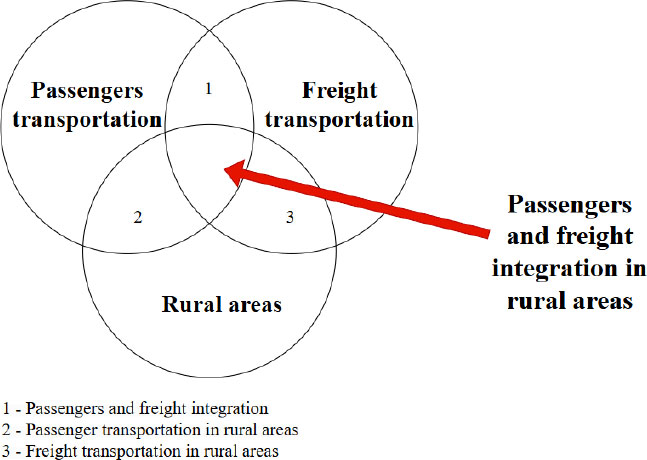
Research topic.
To extend the area of analysis and to evaluate contributions only focusing on this specific topic, several searches were conducted considering different strings, each of them composed of (“Rural”) AND (Passengers-related word) AND (Freight-related word); this is because similar services, or services with similar scope, are defined with different names. The aim is to explore the current state of the most recent publications, considering several terms referred to in the “Overview of previous contributions” and combining them with the term “rural”. For example, a search was performed combining “Rural”, which links the topic to rural context without ambiguity, and “DRT”, which introduces the topic of on-demand transportation, also combined with a word coming from the “freight” sector.
The approach followed here, therefore, was to use a wide range of combinations of terms that refer unequivocally to integrated freight and passenger transportation, as indicated by previous works in the literature [28]. Search terms considered are the ones previously referred to in “Overview of previous contributions”; they are represented in Fig. (3).
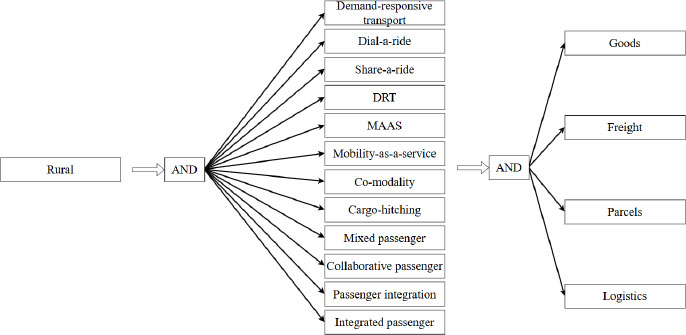
Keywords used as input.
Demand-responsive transport and logistics and its equivalent acronym DRT has been chosen for the role that demand-responsive transport has in this research, as highlighted in” Introduction”; some terms (Cargo-hitching, Share-a-ride, Dial-a-ride, Co-modality) are suggested by Cavallaro & Nocera [28] as expressions often having overlapping meanings; Collaborative passengers, Mixed passengers and Passengers Integration are terms that refer to passenger transport that, if combined with “Freight” or other terms associated with the transport of goods, allow to define the problem without ambiguity.
Finally, Mobility-as-a-Service (MaaS) has been chosen due to its wide range of applications. Other concepts, such as intermodality or multimodality, have been excluded to avoid broadening the scope of responses in fields not directly relevant to the integration between passenger and freight transport.
4. RESULTS
The obtained works are described in detail and characterized according to the year of publication, the country of origin of the research, the geographical characteristics of the evaluated studies, and the methodologies adopted. Eighteen papers are discussed, all of which are related to the problem of integrating goods and passengers in rural areas.
The temporal distribution of contributions is plotted in Fig. (4). The results cover a time span from 2015 to 2024, with a trend similar to the one discussed in the Literature Review section. It should be noted that, excluding the three works published in 2015 and 2019, the publication has been continuous between 2021 and the present, with a notable peak in 2023. The diagram illustrates an increase in attention towards these methods in relation to the rural world, highlighting that the growth has occurred in correspondence with the objectives of Agenda 2030.
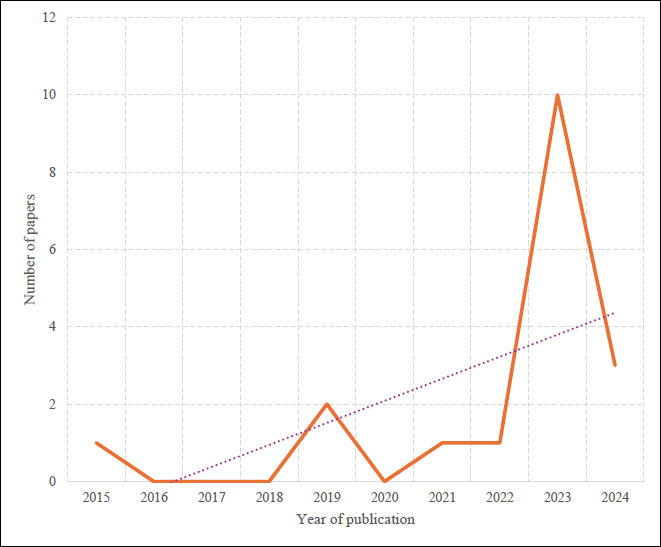
Temporal evolution of studies (Authors' elaboration).
Figure 4 shows a moderate growing trend. The next few years of research will determine whether the high number of publications in 2023 is an outlier or represents a lasting trend. The classification of the results by reference to the country of the universities or research centers of the authors of the different works is proposed.
Figure 5 illustrates the distribution of publications by country, based on the authors' institutional affiliations. Each publication is counted once for every country represented by the authors' universities or research centers. The work is mainly concentrated in East Asia. Seven contributions are from China, and three are from Japan. Several other contributions come from European countries. Sweden is the only country that contributed to three articles, while Italy produced two papers. Therefore, the main characteristic that emerges is linked to the two Eastern countries, where a large part of the population resides in rural areas, particularly in China.
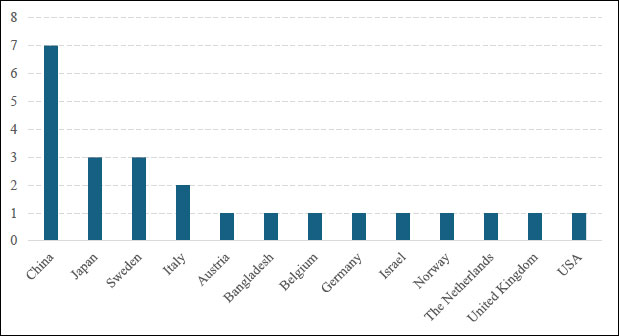
Geographic contribution by country (Authors' elaboration).
Table 1 lists the contributions analyzed. For each contribution, the year and author are indicated, as well as the country of origin and article type. Of the 18 contributions, 5 are conference papers, and 13 are journal articles.
| Authors | References | Country | Category |
|---|---|---|---|
| Molenbruch et al., 2021 | [66] | Belgium, Austria | Journal Article |
| Yang et al., 2023. | [67] | China | Journal Article |
| He & Guan, 2023 | [68] | China, Israel | Journal Article |
| Xue et al., 2024a | [69] | China | Journal Article |
| Xue et al., 2024b | [70] | China | Journal Article |
| He et al., 2023 | [71] | China, Israel | Journal Article |
| Wang et al., 2024 | [72] | China, USA, Sweden | Journal Article |
| Staritz et al., 2023 | [73] | Germany | Conference Paper |
| Cavallaro & Nocera, 2023 | [63] | Italy | Journal Article |
| Cavallaro et al., 2023 | [74] | Japan | Journal Article |
| Namgung et al., 2019 | [75] | Japan | Conference Paper |
| Begnini & Morita, 2023 | [76] | Italy | Journal Article |
| Kamau et al., 2015 | [77] | Japan, Bangladesh | Conference Paper |
| Prillard et al., 2023 | [78] | Norway | Conference Paper |
| Ringsberg, 2023 | [79] | Sweden | Journal Article |
| Zeng & Qu, 2022 | [80] | Sweden, China | Journal Article |
| Van Duin et al., 2019 | [81] | The Netherlands | Conference Paper |
| Franco et al., 2023 | [82] | United Kingdom | Journal Article |
The main recurring sustainability objectives are shown in Table 2. The main results primarily address environmental objectives, such as reducing total kilometers traveled, but also include economic objectives, such as increasing the efficiency of services, and social objectives, such as increasing accessibility and focusing on specific population groups, such as the elderly, elements connected to the SDGs.
| Finding | Dimension of Sustainability | References | UN Targets Related |
|---|---|---|---|
| Reduction in passengers' travel/waiting time; increase in frequency | Economic/Social/Environmental | [68, 72-74, 76, 77] | 11.2 |
| Greater efficiency | Economic | [63, 66, 67, 69-72, 74, 77, 79, 80] | 11.a 7.3 9.1 |
| Use for older adults and low-time sensitivity | Social | [67, 75] | 11.2 11.a |
| Reduction in distance traveled/emissions | Environmental | [63, 67, 68, 71-73, 78, 79, 81] | 13.2 |
| Improve accessibility/increase the area covered | Social | [63, 70, 79] | 11.2 11.a |
5. DISCUSSION
5.1. General Elements
Many contributions highlight the effectiveness of optimization models (often based on integer linear programming or heuristics) in coordinating flows and improving network efficiency [67, 76, 80, 81]. At the same time, research highlights the social value of such systems, especially for the elderly and isolated communities, and the potential for new forms of mobility, sometimes using existing services (like ferries, as highlighted by Ringsberg) [75, 79, 82]. Several studies [63, 66, 73, 74, 78] have proposed methodological frameworks, algorithms, and planning tools to make these services scalable and realistic, with a focus on environmental impacts and the reduction of externalities. Finally, recent contributions demonstrate how urban-rural integration and the adoption of electric vehicles can enhance financial stability, reduce emissions, and promote local development [68-72]. Most analyzed articles propose either an application case study or a simulation/application with data based on case studies from rural territories.
The contributions highlight the role of integrated systems in improving efficiency. The primary reference is related to optimizing the residual capacity of vehicles and improving the organization of vehicle fleets. The improvement of transport system efficiency is related to different targets of Agenda 2030. Mainly, this contribution is linked to Target 11.a “Support positive economic, social and environmental links between urban, peri-urban and rural areas by strengthening national and regional development planning”, and to a less direct but equally significant extent to targets 7.3, on improving energy efficiency, and target 9.1, on infrastructure accessibility.
The objective highlighted by most contributions is the reduction of distances traveled and/or emissions; these results, related to environmental sustainability, have clear economic (such as savings for operators) and social (such as reduction of externalities for the inhabitants of the affected areas) repercussions. This result is related to some of the targets of the 2030 Agenda.
Target 13.2 “13.2 Integrate climate change measures into national policies, strategies and planning” is the most significant in this case for its role in decarbonization. Reducing travel and waiting times for users also has an evident social sustainability relevance, linked to economic and environmental sustainability characteristics.
Several works focus on investigating the accessibility of study areas and the extension of these services to elderly users, both of which are linked to social sustainability. These elements refer directly to Target 11.a and to Target 11.2 “By 2030, provide access to safe, affordable, accessible and sustainable transport systems for all, improving road safety, notably by expanding public transport, with special attention to the needs of those in vulnerable situations, women, children, persons with disabilities and older persons”.
It is worth recalling that all the contributions are rooted in a rural context; therefore, the proposed interventions have an evident dimension of social sustainability, related to improving conditions in rural areas. Indirectly, all the works highlight evolutions with reference to at least two targets: Target 1.1, which aims to reduce poverty regardless of the users' conditions, and Target 1.4, which seeks equal access to services for all men and women. Table 2 summarizes the main findings of the works analyzed in terms of social, economic, and environmental sustainability.
Some comments are proposed on the key aspects that emerged from the set of articles described in the “Methodology” section. The aim is to answer the research questions posed in “Introduction”.
5.2. Temporal and Geographic Characterization (RQ1, RQ2)
The manuscripts considered have shown a greater concentration in recent years. A peak in publications is reached in 2023, when 11 of the 18 articles identified for the eligibility phase are concentrated. The geographical distribution of the authors reveals a scattered interest, but it is mainly localized in Europe and Asia. Japan and China, together, contributed to more than half of the articles (10 out of 18). It is interesting to note that this occurs in countries where some of the most densely populated areas of the planet are located; it is a sign that research is focused on reducing disparities in terms of accessibility to services between urban and rural areas. However, the geographical distribution of the case studies shows applications that are often not comparable. Although most research focuses on the connections between one or more small rural centers and the nearest city, the scale considered is very different and ranges from the City/County level to the small municipality level. From this perspective, many cases are not directly transferable between them. It is essential to note that the extent of the study areas considered varies significantly across the different case studies analyzed. The case studies in Japan are all carried out on the territorial dimension of the city, which encompasses an area that includes both rural and urban territories. The two cases analyzed in Bangladesh are both carried out at the “upazila” level, which in the Bangladeshi territorial subdivision represents the sub-district. The Chinese case studies expressly report a territorial dimension of the County (under Province). The UK cases also explicitly refer to the County; it is appropriate to specify the territorial expansion and population differences between the Chinese and British territories.
On the other hand, the case studies in Central Europe all focus on small municipalities and examine the connection between these and a larger city's territorial reality (these are the cases of Italy, Germany, and the Netherlands). Finally, the two Scandinavian cases focus on municipalities of tiny size (Norway) or smaller islands (Sweden). One element to be verified in future developments is the possibility of making these contributions more scalable, to verify whether the different scales of the study areas lend themselves to the application of the same methodologies.
5.3. Typology of Services (RQ3)
Begnini & Morita [76] proposed a system that combines scheduled and on-demand passenger and freight services on bus lines. Molenbruch et al., [66] analyzed the Dial-a-Ride Problem (DARP), hypothesizing that on-demand dial-a-ride services can be used in rural areas where public transport is unprofitable. The topic addressed by Prillard et al. [78] is related to Cargo-Hitching, in which cargo vehicles can transport passengers, and passenger vehicles can transport small goods. The paper by Yang et al. [67] proposes a Demand-Driven Passenger-and-Freight-Integration Service (DDPFIS) mode in which vehicle fleets can perform both passenger and freight services. Cavallaro & Nocera [63] propose an Integrated Demand-Responsive Transport (I-DRT), with reference to the DRT services mentioned in the introduction, in which the passenger DRT is combined with a freight transport component. Similarly, Staritz et al. [73] define Integrated Demand-Responsive Passenger and Freight Transport (IDRT). The service proposed by Kamau et al. [77] is a Hybrid Multiservice Demand Responsive System, with vehicles provided by a Multiservice Provider. In the context of New Mobility services, Franco et al. [82] propose integrating DRT and scheduled services, possibly extending to freight services. He et al. [71] define the problem as Mixed-Flow Urban-Rural Transit (MFURT) for the transportation of passengers and goods in rural areas using electric buses, and this theme is also represented by Zeng & Qu [80]. From similar bases, but with a greater focus on incentives, He & Guan [68] define the rural bus-integrated transportation service with incentive contracts. A study by Prillard et al. [78] focuses on the proposed Sustainable Transport Planning System; the work describes the tool in the context of integrating different transport services (MaaS), not a single integrated service.
Ringsberg [79] focused on the role of ferries in the context of Integrated Passengers and Freight services (IPF), the only work of the 18 to concentrate on a non-road transport mode. Xue et al. [69] analyzed Public Transport and Logistics Integration (PTLI) in the context of URBI (urban-rural bus integration). A generic urban-rural transit system is analyzed by Wang et al. [72]; similarly, the service proposed by Xue et al. [70] is related to urban-rural passenger and freight integration, but it is mainly focused on postal services. Namgung et al. [75] analyzed the Integrated Transport between Passengers and Goods (ITPG) service. Cavallaro et al. [74] proposed an Integrated Passenger and Freight Transport (IPTF). Two elements are evident. A reduced presence of some terms used in the keyword search (MaaS, Dial-a-ride, Cargo-Hitching), with only one paper each overall. The second element is that many services are often comparable, if not even superimposable; however, the literature has not yet adopted a uniform terminology for defining integrated services. Two articles define IDRTs, two articles MFURTs, while the others define different services but with similar characteristics. Confirming the ambiguity described in a previous study [63], a univocal terminology shared by the literature seems to be missing.
5.4. Sustainability Components (RQ4)
An important element that emerges is that the proposed studies are aligned with the three main dimensions of sustainability. The majority of the articles analyzed highlights the contribution in terms of environmental sustainability among the conclusions: Van Duin et al. [81] underline how Cargo-Hitching can lead to a reduction in emissions, while many of the proposed researches [67, 68, 71-74] highlight that the reduction of the total kilometers travelled is an objective that can be achieved with the application of integrated passenger-freight methodologies in rural areas; the system proposed by Prillard et al. [78] in the context of the Maas allows the pursuit of environmental sustainability objectives; Ringsberg [79] highlights that the use of the residual capacity of ferries and better planning lead to both ecological and economic sustainability objectives. Moreover, various contributions emerge [68, 71, 76, 77] that propose systems allowing for the reduction of travel time, thereby achieving economic savings for the user. Financial sustainability for operators is also achieved through the reduction of operating costs and the optimization of capacity [67, 71, 80]. In some works, the reduction of overall system costs is recommended for operators [66] and for the public authority [69]. All the works indirectly call for social sustainability analysis to improve services in rural areas. It is helpful to recall some specific conclusions of some works: the work of Franco et al. [82] underlines how New Mobility Systems can be used to improve overall services in these areas; Ringsberg [79] emphasizes the role of the services analyzed for the improvement of accessibility; Namgung et al. [75] and Yang et al. [67] relating the proposed services with the value of time, identify how these services are particularly suitable for older adults. Several studies [72, 74] refer to the possibility that the integrated passenger-freight system enables operators to achieve better service efficiency due to access to new sources of financing. All the research highlighted economic, social, or environmental contributions, linking research findings and SDGs. It is helpful to recall that Target 11.2 on access to transport systems is the main guideline for the entire research line; at the same time, many of the contributions analyzed are in line with Target 11.a, which focuses on the links between rural environments and urban and peri-urban environments.
5.5. Models and Methods (RQ5)
Most of the proposed works are related to operational research for optimizing the integrated passenger freight problem under specific constraints. Several studies [63, 67, 68, 70-72, 76, 80] propose models that solve the proposed problem using Mixed Integer Linear Programming or Integer Linear Programming models. Kamau et al. [77] perform simulations starting from the schedules of the proposed services; Xue et al. [69] perform comparisons starting from a cost function; Van Duin et al. [81] propose and describe in detail an analyzed model and a pilot case; the tool proposed by Prillard et al. [78] belongs to the field of planning support tools; Staritz et al. [73] propose an agent-based model; Several other studies [75, 79, 82] focus on statistical analyses starting from surveys, the latter proposing a logit model. Lastly, Cavallaro et al. [74] conducted a Delphi analysis to understand the attributes of a service better. It emerges that the field is of particular interest to operational research, placing the organizers of the services and the public authority at the centre of the study. It emerges that most of the works present in the literature aim to study the system from the service provider's point of view, whether it is for passengers, freight, or an integrated system for passengers and freight. It also emerges that the limited presence of works that study the demand system as a determinant of the functioning of integrated passenger-freight systems, regardless of their organization. In this sense, the problem emerged already from the pioneering work of Enoch et al. [22], familiar to many public services, of supporting the service with external contributions. What seems to be missing is an in-depth analysis of the development of demand for any niches considered, in relation to the services offered. This analysis should estimate, on the one hand, the negative economic differentials generated and, on the other, the positive social and environmental differentials in pursuit of sustainability objectives.
5.6. TSM (RQ5)
All the work refers to specific transport problems, but not all the works adopt a complete TSM approach. It is helpful to verify whether they, in their methodological or applicative components, refer to elements of the Demand System, the Supply System, or the interaction between the two systems. It is essential to emphasize that the current differentiation between the various elements of transportation system modeling is a first-level subdivision, based, in general, on aggregate methodological aspects. As defined in the previous point, the works referring to operational research are 9 [63, 66-68, 70-72, 76, 80]. These works are classifiable as “demand-supply interaction” works. It is essential to recall that these works do not analyze demand; the study of demand is closely tied to users' choices, which is necessary for the mathematical model of the transport system to be effectively studied.
Similarly, the agent-based model proposed by Staritz et al. [73] relates to the interaction between supply and demand. The work proposed by Van Duin et al. [81] adopts the service supply perspective; a portion of demand estimation has been conducted for the proposed application case. He & Guan [69] focus on the service supply; Prillard et al. [78] and Kamau et al. [77] focus on the proposal of supply service, but there is a basic proposal of a scenario on which the service is applied. Cavallaro et al. [74] analyzed characteristics of the proposed IPFT service. Ringsberg [79] studied the demand starting from the analysis of a sample of users of the service; the analysis of the demand starting from the distribution of an SP questionnaire, and calibration of a Logit model, is a central element in the work of Namgung et al. [75]; analysis of the demand through a questionnaire is the main element studied by Franco et al. [82]; this last work is aimed at the study of the entire trip-chain of the users. The prevalence of studies related to the interaction between supply and demand is evident (10 contributions); 5 contributions mainly present a service implementation (mainly supply); 3 contributions focus on analyzing the demand and the characterization of the users.
Some relevant elements may be highlighted to summarize the results. The topic covered is highly innovative but not widely explored in the literature; there are terminological ambiguities in the names adopted for these services; the cases studied are mainly related to Central and Northern Europe, as well as Eastern Asia; there are many contributions from operational research, while there are fewer contributions from demand analysis. Some of these considerations confirm what was previously noted in the literature review [28, 62]. The main relationship between country, year, and component of TSM is represented in Fig. (6).
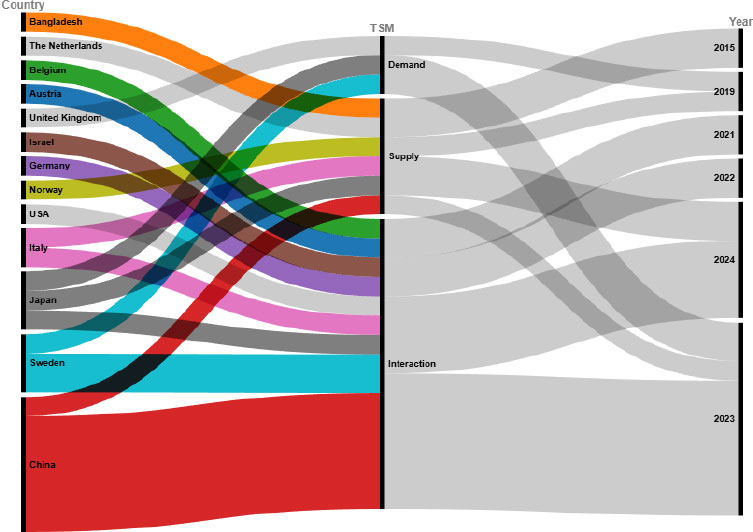
Three-fields plot (Authors' elaboration).
The main advantages offered by the integrated services and their role within the 2030 Agenda have been identified from the literature. The significant role that the topic plays in the context of the sustainability dimensions and the SDGs of the 2030 Agenda is highlighted. All the works analyzed present a clear link with at least one of the dimensions of sustainability. Among the recurring themes are improvements in public transport system efficiency, reductions in total kilometres travelled, decrease in travel times, reduction in emissions, and improvements in accessibility in rural areas. Integrating passenger and freight transport in rural contexts can reduce negative externalities, making the system more efficient. This aspect is relevant considering the typical difficulties of transport in rural areas, characterized by low-density demand and the need to guarantee an adequate service. These themes are connected to the goals of the 2030 Agenda, with an apparent reference to targets 11.2 and 11.a within Goal 11, “Sustainable cities and communities”. The work shows the hypothesized advantages of these systems in rural areas.
The use of on-demand passenger transport in rural areas often does not guarantee system efficiency; integrating it with freight transport could ensure better overall efficiency compared to traditional scheduled collective passenger transport, which frequently exhibits inefficiencies in rural areas.
The importance of integrating passenger and freight services to ensure environmental, economic, and social sustainability in rural areas is highlighted. There are different studies aimed at analyzing demand and supply. In general, the approach of these works tends to be more oriented toward proposing a service or an Integrated Service System, considering demand as input data. The in-depth analysis of demand is an element that should undoubtedly be explored in greater detail by subsequent studies. It has also been highlighted how the case studies analysed, although all refer to “rural” areas, present different characteristics. In this sense, an approach is more oriented towards constructing solutions oriented to the specific case, rather than general models.
CONCLUSION AND FUTURE WORKS
This work presents a general overview of integrating passenger and freight transportation in rural areas. Several studies on the topic of passenger-freight integration were conducted. In-depth spatial and temporal analyses have been conducted on the set of studied articles, and qualitative analyses of the content have been presented. The results show growing interest in the topic, a varied geographical distribution, but primarily concentrated in a few countries (China, Japan, and European countries). The paper also demonstrated a wide range of applications for integrated services, confirming several hypotheses in the literature. This work provides a comprehensive foundation that summarizes the key elements of research on the topic. Considering the main findings of this work, the note is helpful for researchers because it provides an analysis of the topic and provides a common background on passenger-freight integration, highlighting the methodological and applicative steps of the progress of the topic discussed. Furthermore, it is of particular interest to policymakers, planners, and operators of public transport and logistics, because it provides the current state of the art and the elements of strength and criticality of integrated passenger-freight services present in the literature, being of interest for those who should proceed with the design or modelling of an integrated service in a rural area.
AUTHORS’ CONTRIBUTIONS
The authors confirm contribution to the paper as follows: A.R. and T.C.: Conceptualization; A.R.: Methodology; A.R.: Software; A.R., T.C.: Validation; A.R.: Formal analysis; A.R.: Investigation; T.C.: Resources; A.R.: Data curation, A.R.: Writing-original draft preparation; T.C. and M.A.A.-R.: Writing-review and editing; M.A.A.-R.: Visualization; G.T.: Supervision; G.T.: Project administration; G.T. and T.C.: Funding acquisition. All authors have read and agreed to the published version of the manuscript.
LIST OF ABBREVIATIONS
| DARP | = Dial-a-Ride Problem |
| DDPFIS | = Demand-Driven Passenger-and-Freight-Integration Service |
| DRT | = Demand Responsive Transport |
| IDRT | = Integrated Demand-Responsive Transport |
| IPF | = Integrated Passengers and Freight |
| ITPF | = Integrated Passenger and Freight Transport |
| ITPG | = Integrated Transport between Passengers and Goods |
| MaaS | = Mobility-as-a-service |
| MFURT | = Mixed-Flow Urban-Rural Transit |
| PTLI | = Public Transport and Logistics Integration |
| SDGs | = Sustainable Development Goals |
| SLR | = Systematic Literature Review |
| TSM | = Transportation System Models |
| URBI | = Urban-Rural Bus Integration |
CONFLICT OF INTEREST
Dr. Antonio Russo is the Editorial Advisory Board Member of The Open Transportation Journal.
Dr. Tiziana Campisi is the Editor-in-Chief of the journal The Open Transportation Journal.
The author, Dr. Giovanni Tesoriere, is the Editorial Advisory Board Member of The Open Transportation Journal.
ACKNOWLEDGEMENTS
Research Activities were supported by the MUR (Italian Ministry of University and Research, Italy) through SMART3R-FLITS: SMART Transport for Travellers and Freight Logistics Integration Toward Sustainability (Project protocol:2022J38SR9_03, CUP Code: J53D2300 9330008), financed by the PRIN 2022 (Research Projects of National Relevance) programme.